Visiting Cordoba Alcazar: your planning guide
The Alcázar de los Reyes Cristianos is a fortified palace in Córdoba best known for its terraced gardens, tower views, and layered Roman, Islamic, and Christian history. The visit is compact rather than overwhelming, but it rewards a smart sequence: interiors first, towers next, gardens last, especially in warmer months. The biggest thing that catches people out is the strict timed entry window. This guide covers when to go, how long to allow, which ticket to book, and how to move through the site well.
Quick overview: Alcázar de los Reyes Cristianos at a glance
- When to visit: Tuesday–Sunday; Monday is closed, and Thursday evenings after 6pm are free. The first 90 minutes on Tuesday or Wednesday are noticeably calmer than Thursday free-entry evenings and late spring mornings, because combo visitors and budget travelers tend to bunch up then.
- Getting in: From €5 for standard entry. Guided tours usually start from around €20. Book ahead for April, May, long weekends, and free Thursday evenings; in quieter winter weeks, a day or two ahead is often enough.
- How long to allow: 1.5–2 hours for most visitors. It stretches closer to 2 hours if you climb a tower, explore the baths, and take your time in the gardens.
- What most people miss: The Royal Baths below the Hall of Mosaics and the Patio Morisco are easy to rush past, even though they add more historical depth than another garden photo stop.
- Is a guide worth it? Yes if you want the Reconquista, Inquisition, and Columbus connections explained clearly; if you’re mainly here for the gardens, views, and a compact wander, self-guiding works fine.
🎟️ Timed slots for Alcázar de los Reyes Cristianos can sell out a few days in advance during April, May, and holiday weekends. Lock in your visit before the time you want is gone.
Jump to what you need
🕒 Where and when to go
🗓️ How much time do you need?
🎟️ Which ticket is right for you?
🗺️ Getting around
♿ Facilities and accessibility
Where and when to go
How do you get to Alcázar de los Reyes Cristianos?
The Alcázar sits in Córdoba’s historic center near the Guadalquivir River, beside Puerta de Sevilla and a short walk from the Mezquita-Cathedral.
→ Calle Caballerizas Reales, s/n, 14004 Córdoba, Spain | Find on Google Maps
- Walk: From the Mezquita-Cathedral → 5–7 min → easiest route through the Judería.
- Bus: Lines 3 and 12 → Puerta Sevilla stop → 2–3 min walk to the monument.
- Taxi / rideshare: Drop-off at Campo Santo de los Mártires → 1–2 min walk to the entrance.
- Train station: Taxi from Córdoba station → about 10 min → easiest if you’re on a tight timed slot.
Which entrance should you use?
The entrance setup is simple, but visitors often head to the first gate they see instead of the one that best fits their access needs.
- Main entrance / Tower of Lions side: Located at Campo Santo de los Mártires. Best for most timed-entry visitors. Expect 10–20 min wait on spring mornings.
- Baroque entrance: Located on the accessible side entrance into the gardens. Best for wheelchair users, strollers, and anyone avoiding steps. Expect slightly shorter waits outside peak windows.
When is Alcázar de los Reyes Cristianos open?
- Monday: Closed.
- Tuesday–Sunday: Opening hours vary by season and on public holidays.
- Thursday evening: Free entry after 6pm.
When is it busiest? Thursday free-entry evenings, late spring mornings, and festival periods in April and May are the busiest, with longer entrance queues and fuller gardens.
When should you actually go? Go in the first morning wave on Tuesday or Wednesday if you want cooler tower climbs, quieter courtyards, and more room in the gardens before combo visitors arrive.
Thursday after 6pm is free, but it’s rarely the easiest time to visit. If your budget allows it, a paid Tuesday or Wednesday morning slot usually saves more time than the free evening saves money.
How much time do you need?
| Visit type | Route | Duration | Walking distance | What you get |
|---|---|---|---|---|
Highlights only | Entrance → Hall of Mosaics → Patio Morisco → Tower of Lions → gardens → exit | 1–1.25 hrs | 1 km | You cover the signature rooms, one tower, and the main garden axis, but you’ll likely skip the baths and linger less outdoors. |
Balanced visit | Entrance → Hall of Mosaics → Royal Baths → Patio Morisco → Tower of Lions → palace rooms → gardens → exit | 1.5–2 hrs | 1.3 km | This is the best fit for most visitors because it adds the baths and enough garden time to make the historical layers feel connected. |
Full exploration | Entrance → palace rooms → Hall of Mosaics → Royal Baths → both tower areas where accessible → full garden circuit → photo stops → exit | 2–2.5 hrs | 1.6 km | You get the full mood of the site, including slower time in the gardens and viewpoints, but the extra value depends on how much you enjoy stairs, history panels, and repeated photo stops. |
All Alcázar-only routes work on standard entry. Combo tickets only matter if you’re pairing the Mezquita-Cathedral or Judería on the same day.
The full route is harder without context because the baths, mosaic hall, patios, and towers aren’t explained in a clear sequence on site. A guided tour ties the Roman, Islamic, and Christian layers together and saves you from doubling back.
Which Cordoba Alcazar ticket is best for you
| Ticket type | What's included | Best for | Price range |
|---|---|---|---|
Standard admission ticket | Timed entry + palace access + gardens access | A self-guided visit where you want the lowest-cost way in and are happy to read the rooms and pace yourself. | From €5 |
Guided tour | Timed entry + licensed guide + palace access + gardens access | A first visit where the history matters to you and you don’t want to piece together Roman, Islamic, and Christian layers on your own. | From €20 |
Combo: Alcázar + Mezquita-Cathedral | Entry to Alcázar + entry to Mezquita-Cathedral | A short stay in Córdoba where you want the city’s 2 headline monuments on the same day without booking separate entries. | From €20 |
Combo: Alcázar + Jewish Quarter + Mezquita-Cathedral | Entry to Alcázar + Jewish Quarter access + Mezquita-Cathedral entry | A full old-town day where you’d rather follow one historic route than juggle multiple standalone bookings. | From €25 |
Street vendors and kiosks near Alcázar de los Reyes Cristianos can sell overpriced or unclear combo tickets. Buy only through the official site or a verified partner — an invalid ticket means joining the longest queue anyway, with no recourse.
How do you get around Alcázar de los Reyes Cristianos?
Layout and suggested route
The Alcázar is best explored on foot in about 1.5–2 hours, and while it isn’t huge, the mix of indoor rooms, underground baths, towers, and gardens makes the visit feel more layered than it first looks. The main palace spaces sit near the entrance, while the gardens spread out behind them toward the river side of the complex.
- Hall of Mosaics → Roman mosaic panels and core interpretation space → 10 min.
- Royal Baths → vaulted medieval bath chambers below the palace → 10 min.
- Tower of Lions → best all-round panorama over the old town and river → 10–15 min.
- Terraced gardens → fountains, long pools, and the most photogenic part of the visit → 30–45 min.
Suggested route: Start indoors while your energy is highest, do the baths before the towers, and leave the gardens for last. Most visitors do the reverse and end up backtracking to find what sits below the main palace rooms.
Maps and navigation tools
- Map: A simple site map is easiest to save before arrival, especially if you want to connect the rooms, baths, and gardens in one loop.
- Signage: Wayfinding is decent for the main route, but it’s easy to miss the baths and smaller historic spaces if you only follow crowd flow.
- Audio guide / app: No Audioguide is included with basic entry, so an app-based tour or live guide adds more value here than at a more straightforward monument.
💡 Pro tip: Don’t head straight into the gardens after entry. Do the interiors and baths first, then finish outside when the route opens up and photo stops feel less rushed.
What are the most significant spaces in Cordoba Alcazar?

Terraced gardens
Era: Restored Andalusian-style palace gardens
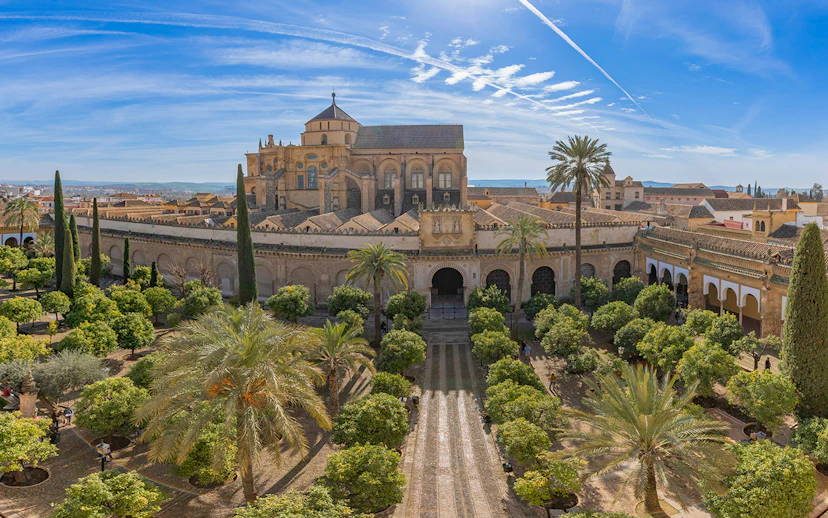
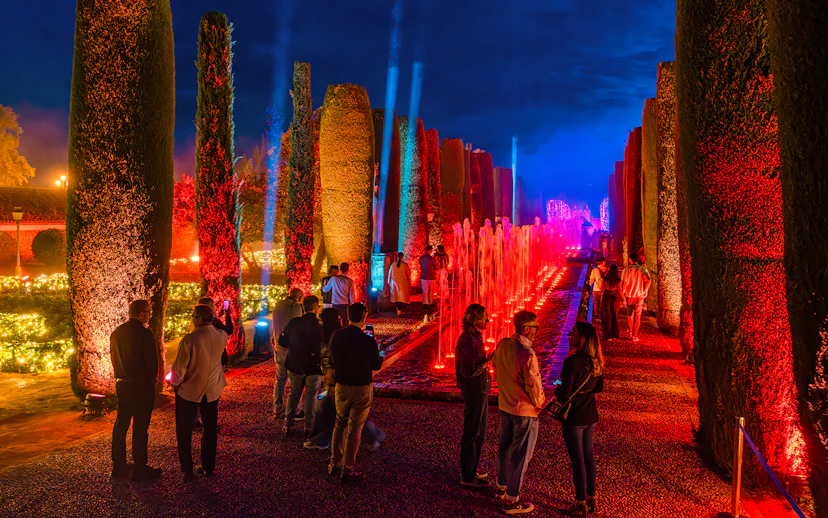
The gardens are the emotional payoff of the visit: long pools, clipped hedges, palms, cypress trees, and fountains set against fortress walls. They’re where the Alcázar feels least like a museum and most like a place to linger. What many visitors miss is how much the garden layout echoes older Islamic water design, so don’t just rush to the center axis for photos and leave.
Where to find it: Behind the palace rooms, spreading south through the lower terraces.
Tower of Lions
Attribute — Tower type: Main entrance tower and viewpoint
This is the climb most visitors do, and it earns it with one of the best compact views in Córdoba — the Mezquita-Cathedral dome, the Jewish Quarter rooftops, the gardens, and the Guadalquivir all fall into one frame. What people often miss is the carved lion gargoyles and the tiny chapel space associated with the tower rather than just the panorama at the top.
Where to find it: At the main entrance side of the complex, reached early in the visit route.
Hall of Mosaics
Attribute — Archaeological highlight: Roman mosaic collection
The Hall of Mosaics gives the site much of its depth, because it reminds you the Alcázar stands on far older Roman foundations. The mosaics are vivid enough to hold attention even if you don’t usually stop for floor panels, and the mythological scenes reward a closer look. Many visitors glance once and move on without noticing how large the recovered panels actually are.
Where to find it: Inside the main palace block, usually one of the first major rooms after entry.
Patio Morisco
Attribute — Architectural style: Mudéjar courtyard
The Patio Morisco is quieter and smaller than the big gardens, but it’s one of the most balanced spaces in the whole monument, symmetrical planting beds, water channels, and a central fountain in a tight, controlled layout. It’s easy to miss because people use it as a transition space between bigger stops. Slow down here for the atmosphere and the cooler microclimate created by the water.
Where to find it: In the inner palace section, between the main rooms and the outdoor route.
Royal Baths
Attribute — Historic function: 14th-century bath complex
The baths feel completely different from the bright courtyards above: low light, brick vaulting, stone basins, and star-shaped skylights that make the space feel almost hidden. This is where the Alcázar’s Islamic influence becomes most tangible. Many visitors skip it because it sits below the main route, but it’s one of the most memorable parts of the visit if you care about the site’s layered history.
Where to find it: Down the stairway below the Hall of Mosaics, beneath the palace area.
The Royal Baths below the Hall of Mosaics and the smaller details inside the Tower of Lions. Both are easy to miss because most visitors follow the crowd straight to the gardens and viewpoint.
Facilities and accessibility
- 🎒 Bag check: Bags go through a quick security scan at entry, so a small day bag is much easier than a large backpack on a timed slot.
- 🪑 Seating / rest areas: The best places to pause are in the gardens, especially along the long pools and shaded edges rather than in the indoor rooms.
- 🅿️ Parking: There’s no simple on-site lot for the monument itself, but nearby paid parking and taxi drop-offs around Campo Santo de los Mártires are the easiest arrival option.
- 🍽️ Food options: Treat the Alcázar as a before-lunch or pre-dinner visit, because the better food options are outside the monument in the Judería.
- 📶 Wi-Fi: Don’t count on solving navigation on the spot with venue Wi-Fi; save what you need before you arrive.
- ♿ Mobility: Accessibility is partial rather than full — the Baroque entrance offers step-free access into the gardens, but the towers, baths, and several historic areas still involve stairs.
- 👁️ Visual impairments: On-site labels are fairly brief, so spoken context from a guide or app helps more here than at a monument with stronger room-by-room interpretation.
- 🧠 Cognitive and sensory needs: The quietest windows are the first morning slots on Tuesday or Wednesday, while Thursday free-entry evenings and spring late mornings feel much busier.
- 👨👩👧 Families and strollers: Strollers work best in the gardens and main courtyards, but you’ll need to leave them aside for the towers, baths, and tighter indoor sections.
This works well for children if you treat it as a short castle-and-gardens visit rather than a long history lesson.
- 🕐 Time: 60–90 min is realistic with younger children if you focus on 1 tower, the baths, and the gardens instead of reading every panel.
- 🏠 Facilities: The gardens are the easiest family section because children can move more freely there than in the enclosed palace rooms.
- 💡 Engagement: Turn the visit into a spotting game — lion gargoyles, star-shaped skylights, fountains, and the Mezquita dome are easy wins.
- 🎒 Logistics: Bring water, sun protection, and only a light stroller if you need one, because heavier gear becomes frustrating on stairs and tight passages.
- 📍 After your visit: The Roman Bridge is an easy follow-up nearby and gives children open space after the more structured monument route.
Rules and restrictions
What you need to know before you go
- Timed entry is standard, and the biggest mistake here is arriving late enough to miss your slot.
- Reduced or free admission categories can require ID, so carry it if you’re using a discounted ticket.
- Bags are screened at entry, and traveling light makes a bigger difference to waiting time than people expect.
- Re-entry isn’t something to count on for a casual break, so plan coffee, food, and restroom stops before you enter.
- There’s no enforced dress code, but sun protection and shoes with grip make the garden paths and tower stairs much easier.
Not allowed
- 🚬 Smoking / vaping: Keep smoking outside the monument, since the palace rooms, courtyards, and gardens are visitor areas.
- 🐾 Pets: Pets aren’t part of the normal visit, though service animals should travel with the right documentation.
- 🖐️ Touching exhibits / climbing: Don’t climb on fountains, walls, or display areas, because the stonework and Roman pieces are fragile.
Photography
- Casual photography is one of the pleasures of visiting the Alcázar, and personal photos are generally fine in the palace, courtyards, and gardens.
- The practical distinction is space rather than prestige: the gardens and tower viewpoints are easiest for photos, while tighter interiors and restored areas may have temporary limits or less room to stop.
- Flash is best avoided around mosaics and enclosed historic spaces, and bulky video gear can slow you at security.
Good to know
- Thursday after 6pm is free, but it’s often the least relaxed time to visit because queues grow before the evening window opens.
- Visitors expecting a richly furnished palace are often surprised that the real highlights are the gardens, baths, towers, and mosaics rather than lavish royal interiors.
Practical tips
- Book at least 2–3 days ahead for April, May, and long weekends, because the issue here isn’t just sellout risk — it’s getting a timed slot that still lets you pair the Mezquita-Cathedral comfortably on the same day.
- Arrive 15–20 minutes before your slot, not 1 minute before it; reviews repeatedly mention that late arrivals get caught out by the strict timing even when the delay is minor.
- Do the interiors and baths first, then the tower, then the gardens — people who start in the gardens often use up their coolest energy outside and rush the historically richest indoor spaces.
- If you’re deciding between a Thursday free evening and a paid weekday morning, choose the morning unless price is your top priority; the free window is cooler, but it’s also one of the busiest.
- Bring water and a small bag, and leave bulky gear behind; security is quick, but larger bags slow entry and become annoying on tower stairs and in the bath complex.
- Eat before entering if your slot falls near standard Spanish lunch hours, because once you’re inside, the visit is short enough that it’s better to finish cleanly and then head into the Judería for tapas.
What else is worth visiting nearby?
Commonly paired: Mezquita-Cathedral
- Distance: 600 m — 8 min walk
- Why people combine them: They’re Córdoba’s 2 essential historic monuments, close enough to do back-to-back without wasting time in transit.
Commonly paired: Jewish Quarter and Synagogue
- Distance: 350 m — 5 min walk
- Why people combine them: The route between them feels natural on foot, and the Alcázar makes more sense once you see the wider old-town fabric around it.
Also nearby
Roman Bridge
- Distance: 500 m — 7 min walk
- Worth knowing: It’s the easiest post-visit detour if you want river views and one of the best exterior angles back toward the Alcázar area.
Royal Stables of Córdoba
- Distance: 150 m — 2 min walk
- Worth knowing: This is the most convenient add-on if you want another short historic stop without crossing back through the old town.
Eat, shop and stay near Cordoba Alcazar
- On-site: There isn’t a full meal stop inside the monument, so plan to eat before or after your visit rather than during it.
- Taberna Caballerizas Reales (2-min walk, Calle Caballerizas Reales): Drinks and light bites, and the closest easy fallback if your timed slot leaves little room to roam.
- Casa Pepe de la Judería (7-min walk, Calle Romero 1): Classic Cordoban dishes at a mid-range price point, and a reliable sit-down option after the Alcázar.
- Bodegas Mezquita Corregidor (8-min walk, Calle Corregidor Luis de la Cerda 73): Popular tapas, efficient service, and an easy next stop if you’re heading toward the Mezquita afterward.
- Pro tip: The old town gets much busier around lunch, so either eat before 1pm or wait until after 3pm if you want a calmer meal near the monument.
- Zoco Municipal de Artesanía: Handmade leather goods, ceramics, and artisan work, and a better souvenir stop than the generic magnet stalls around the busiest lanes.
- Judería craft shops: Good for small ceramics, olive-wood pieces, and Córdoba-themed gifts if you want something quick on the walk toward the Mezquita.
Staying near the Alcázar works well if you want to wake up inside Córdoba’s most atmospheric quarter and walk everywhere in the historic center. The trade-off is logistics: streets are tighter, parking is trickier, and prices can be a little higher than around the station or newer center. For a 1–2 night old-town stay, though, it’s a strong base.
- Price point: Mid-range to upper-mid-range, with the biggest premium attached to location and character rather than hotel facilities.
- Best for: Short stays where walking to the Alcázar, Mezquita, Roman Bridge, and evening tapas matters more than driving convenience.
- Consider instead: Stay closer to Córdoba station or the modern center if you’re arriving by train with luggage, using a rental car, or staying longer and want easier transport links.
Frequently asked questions about visiting Cordoba Alcazar
Most visits take 1.5–2 hours. If you only want the core rooms, 1 tower, and a short garden walk, you can finish in about 1 hour, but the baths and slower time in the gardens are what usually push the visit closer to 2 hours.
Yes, booking in advance is the safer move, especially in April, May, on long weekends, and for Thursday free-entry evenings. The Alcázar uses timed entry, so the real advantage isn’t only getting in — it’s getting a slot that still works with the rest of your day in Córdoba.
Yes, it can be worth it if you’re visiting in spring, on a holiday weekend, or you’re pairing the Alcázar with the Mezquita-Cathedral on a tight schedule. This isn’t a site with massive all-day waits, but short entrance delays matter more because timed entry is enforced strictly.
Arrive about 15–20 minutes early. That gives you enough buffer for security, the correct entrance, and any line buildup without cutting it so fine that a small delay puts your slot at risk.
Yes, you can bring a small bag or backpack, but expect a quick security check at entry. A light day bag is the sweet spot here because bigger bags slow you down and become annoying on stairs, especially at the towers and baths.
Yes, casual photography is generally allowed. The gardens and tower viewpoints are the easiest places to shoot, while tighter interiors may require a quicker flow, and flash is best avoided around mosaics and enclosed historic areas.
Yes, it works well for families if you keep expectations realistic and treat it as a short castle-and-gardens stop. Most children do best with a 60–90 minute route focused on 1 tower, the baths, fountains, and the gardens rather than a long history-heavy visit.
It is partly accessible, but not fully. The Baroque entrance gives step-free access into the gardens, while the towers, baths, and some historic rooms still involve stairs, so visitors using wheelchairs will get a meaningful but partial version of the site.
Food is available very close by, but not as part of the main visit itself. The Judería and Mezquita area are full of tapas bars and sit-down restaurants within a 5–10 minute walk, so it’s better to eat before or after your slot.
The Alcázar is closed on Mondays. Holiday schedules can also affect access, so it’s worth checking the live calendar for your specific date rather than assuming the standard weekly pattern will hold.